



Social Media Use Cases: From One Idea to Every Channel | JarveePro
Your Business Has Seven Channels. Why Are You Still Managing Them One by One?
A customer publishes a new article on the company website.
Then someone opens Facebook and writes a post about it.
Another person prepares an Instagram version.
Someone else rewrites it for X.
A video editor turns the same idea into a short video for TikTok.
The LinkedIn version gets written later.
And three days afterward, somebody remembers they never published it to the company YouTube channel.
Nothing is technically broken.
There is no dramatic marketing failure.
The business simply has too many places to be present, and too many small actions required to remain present in all of them.
This is the kind of problem that becomes interesting only after a business grows.
And it is one reason a new generation of social-media software is moving beyond the idea of a simple scheduler.
The Business That Already Has the Content
Consider a small software company launching a new feature.
The marketing team already has:
- a website
- a blog
- X
- TikTok
- YouTube
They don't need someone to invent eight completely different marketing campaigns.
They have one story:
We launched something new.
From that one story, however, they need many executions.
The website gets the detailed announcement.
LinkedIn gets the business angle.
X gets the concise version.
Facebook gets a community-oriented post.
Instagram gets a visual.
TikTok gets a short video.
YouTube gets a video explanation.
The underlying idea is the same.
The format, wording, timing and context are different.
That distinction matters.
The marketing challenge isn't always creating more content.
Sometimes it is making one good idea travel further.
Case 1: The Founder Who Publishes Once
A founder writes a thoughtful article at 9 a.m.
It takes two hours.
The article contains:
- research
- examples
- statistics
- a product announcement
- several useful ideas
It gets published on the website.
Then the founder moves on to the next task.
The article may eventually receive search traffic.
But something interesting has happened.
The company created an asset once, then stopped using it.
What if the article became:
Website
→ Full article
→ Three business insights
X
→ Five short observations
→ Discussion post
→ Quote/image carousel
YouTube
→ Short explanation
TikTok
→ One surprising idea from the article
Newsletter
→ Summary and link
Suddenly, the original article isn't merely a blog post.
It becomes a source document for a distribution system.
This is the first use case worth understanding.
One idea can become many pieces of communication.
Case 2: The Company With 50 Accounts
Now make the situation more interesting.
Instead of one brand account, imagine a company managing accounts for:
- different products
- different regions
- different brands
- different communities
- different business units
The content is related, but the accounts aren't identical.
A U.S. account might publish one version.
A Latin American account might use another.
A product account might focus on features.
A corporate account might focus on industry trends.
The problem isn't simply:
“How do I schedule a post?”
It becomes:
“How do I manage a network of digital identities without treating every account as a separate job?”
That is a fundamentally different problem.
At this point, spreadsheets start becoming surprisingly important.
And that is usually a warning sign.
Case 3: The Marketing Team That Wants to React Faster
A company notices something happening in its industry.
A topic starts appearing repeatedly across social media.
Customers are asking the same question.
Competitors are discussing it.
People are arguing about it.
The company's marketing team could publish something useful.
But first someone needs to:
- discover the topic
- understand it
- decide whether it matters
- create content
- adapt the content
- publish it
- monitor the reaction
By the time all seven steps are finished, the conversation may already have moved somewhere else.
This is where monitoring and publishing become connected activities.
The valuable system isn't simply:
Find trends.
It is:
Find something → understand it → turn it into content → distribute it → observe what happens.
That is much closer to an operating loop than a posting calendar.
Case 4: The Agency With Different Clients
Now consider an agency.
One client sells software.
Another sells fitness products.
Another operates a restaurant.
Another publishes financial education.
Another runs an ecommerce store.
The agency doesn't need the same content.
But it repeatedly needs the same workflow:
Research → Create → Adapt → Publish → Monitor → Report
The difference is the customer, audience and content.
The underlying machinery is remarkably similar.
This is where automation becomes less about replacing a person and more about turning a repeatable process into infrastructure.
Case 5: The Website Is the Beginning, Not the End
Here's a particularly interesting use case.
A company publishes a new WordPress article.
Traditionally, the workflow might end there.
But imagine the article becoming the starting point:
WEBSITE │ New article │ ┌──────────┼──────────┐ ↓ ↓ ↓ LinkedIn Facebook X │ │ │ ↓ ↓ ↓ Discussion Community Short post │ ┌──────────┼──────────┐ ↓ ↓ ↓ Instagram TikTok YouTube
The website remains the company's owned publishing platform.
Social networks become distribution channels.
The content doesn't need to be recreated from zero every time.
It needs to be translated into the language of each channel.
That is a very different way of thinking about social media.
Case 6: When “Post Everywhere” Isn't Enough
There is a trap here.
A business might think:
“Great. I'll just publish the same thing everywhere.”
But platforms don't work identically.
A 1,500-word article isn't an Instagram post.
A LinkedIn explanation isn't necessarily a TikTok script.
An X post has a different rhythm from a YouTube description.
So the interesting use case isn't:
One click → identical post everywhere.
It is:
One idea → multiple appropriate executions.
That's where AI becomes useful.
AI can help transform the underlying idea.
Automation can help execute the resulting workflow.
The two capabilities are complementary.
Case 7: The Company That Doesn't Know Which Channel Matters
There is another scenario that happens all the time.
A company has:
- X
- TikTok
- YouTube
But nobody really knows which conversations matter.
So the team keeps publishing.
More posts.
More videos.
More graphics.
More captions.
More hashtags.
The volume increases.
The understanding doesn't.
A more sophisticated workflow starts somewhere else:
Listen first.
Look at:
- customer questions
- recurring complaints
- emerging topics
- competitor conversations
- comments
- search behavior
- industry news
- community discussions
Then create content around what appears meaningful.
This changes the role of automation.
Automation doesn't have to mean “do more things faster.”
It can mean:
“Once we understand what matters, make the execution repeatable.”
The Hidden Shift: From Posts to Systems
This is the part many businesses don't notice.
At the beginning, social media feels like a collection of posts.
Eventually, it starts looking like a system.
There are:
Identities
Facebook Page
Instagram account
X account
TikTok account
LinkedIn profile
YouTube channel
Website
Content
Articles
Images
Videos
Short posts
Questions
Announcements
Promotions
Timing
When should something appear?
Targeting
Who should see it?
Conversation
Where are people already discussing the subject?
Monitoring
What is changing?
Measurement
What happened after publication?
Once you see all of these pieces together, a social-media platform stops looking like a simple scheduling tool.
It starts looking more like infrastructure for running a digital presence.
This Is Where JarveePro Nexus Enters the Picture
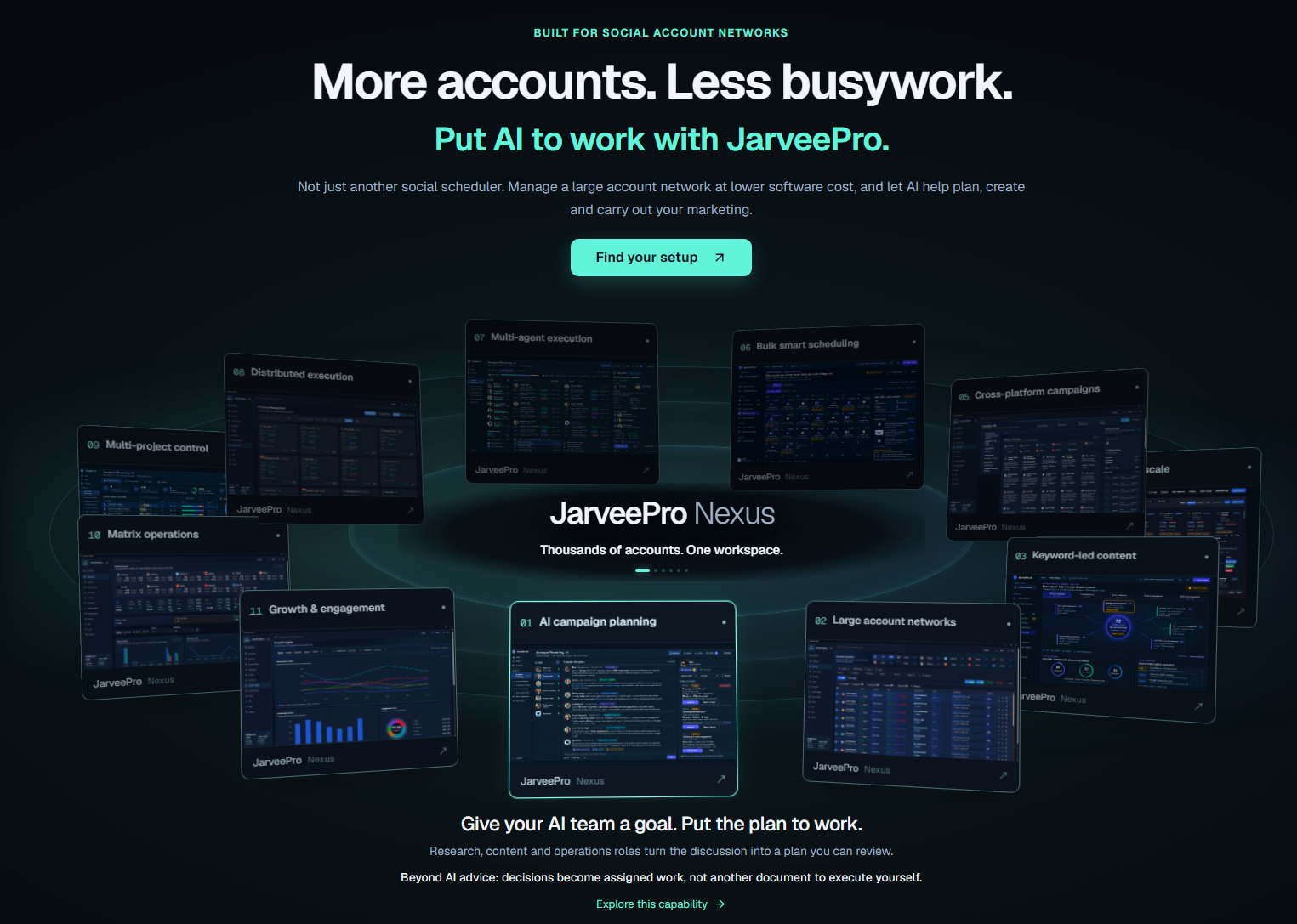
JarveePro has historically been associated with social-media automation.
But the larger direction behind JarveePro Nexus is more interesting than simply automating another posting calendar.
The idea is to bring together the different pieces of the workflow:
Discover
→ What is happening?
Understand
→ Why does it matter?
Create
→ What should we say?
Adapt
→ How should it appear on each channel?
Distribute
→ Where should it go?
Monitor
→ What happened?
Learn
→ What should we do next?
That creates a loop:
Listen → Understand → Create → Distribute → Measure → Listen Again
The software becomes less visible to the customer.
And that is actually a good thing.
Nobody wants to wake up thinking:
“I really need a better API integration today.”
They want to wake up thinking:
“We have something important to say. Let's get it in front of the right people.”
The API Is the Plumbing
Underneath this kind of system are APIs.
Facebook has its own developer ecosystem.
Instagram has its own APIs.
X has its own API.
TikTok has its own APIs.
LinkedIn has its own APIs.
YouTube has its own APIs.
WordPress has its own REST API.
They all speak different technical languages.
A business owner shouldn't have to learn all of them.
The purpose of a platform such as Nexus is to create a layer between the business intention and the technical infrastructure.
The user thinks:
Publish this announcement to my connected channels.
The system deals with the details.
That is the difference between using APIs and building a product around APIs.
The Customer May Never Know the Software Is Doing It
This is perhaps the most important marketing insight.
The future customer may not search for:
“AI social media automation platform.”
They may search for something much more ordinary:
“How can I publish my WordPress articles to social media?”
Or:
“How do I manage multiple social media accounts?”
Or:
“How can one marketing team manage Facebook, Instagram, LinkedIn and TikTok?”
Or:
“How do I turn one blog post into social media content?”
Or:
“How can I manage social media for multiple brands?”
These are use cases.
The customer doesn't need to know the category of software before discovering the software.
That is why marketing an intelligent platform shouldn't begin with:
“Here is our software.”
It can begin with:
“Here is what someone like you is trying to accomplish.”
The Real Opportunity Is Invisible to the Customer
There is a curious pattern in technology.
People often don't search for the technology that will eventually solve their problem.
They search for the job they are trying to get done.
Someone doesn't necessarily search for:
“Content distribution infrastructure.”
They search:
“How do I promote my blog?”
They don't search:
“Multi-channel publishing abstraction.”
They search:
“How do I post to Facebook, Instagram and LinkedIn at the same time?”
They don't search:
“Social intelligence workflow.”
They search:
“How do I find what customers are talking about?”
This is why use-case marketing matters.
The customer doesn't have to understand Nexus before Nexus can become relevant to them.
From Software Features to Situations
This suggests a different way to introduce JarveePro.
Instead of starting with:
AI Agent
API
Automation
Scheduler
Multi-account management
Start with situations:
“You published a blog post. Now what?”
“You manage 30 social accounts. How do you keep them organized?”
“Your company has one idea but seven channels.”
“Your customers are already talking about the problem you solve.”
“Your marketing team spends more time publishing than thinking.”
“You have content. You just aren't distributing it.”
Each story introduces a different doorway into the same system.
The customer recognizes themselves before they recognize the product.
And that's often where good software marketing begins.
The Bigger Idea
Social media started as a place where people published things.
Then businesses learned to schedule.
Then they learned to automate.
Now the interesting question is becoming something else:
Can software understand what a business is trying to accomplish and coordinate the many small actions required to make it happen?
That is a much bigger question than:
“Can I schedule a Facebook post?”
And it is also why the next generation of social-media software may look less like a calendar and more like an operating layer for a company's digital presence.
The customer doesn't need to know what API is underneath.
They just need to know what becomes possible when all those disconnected channels finally start working together.